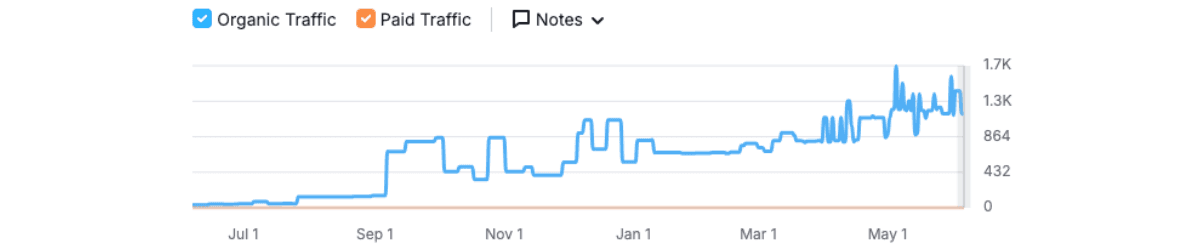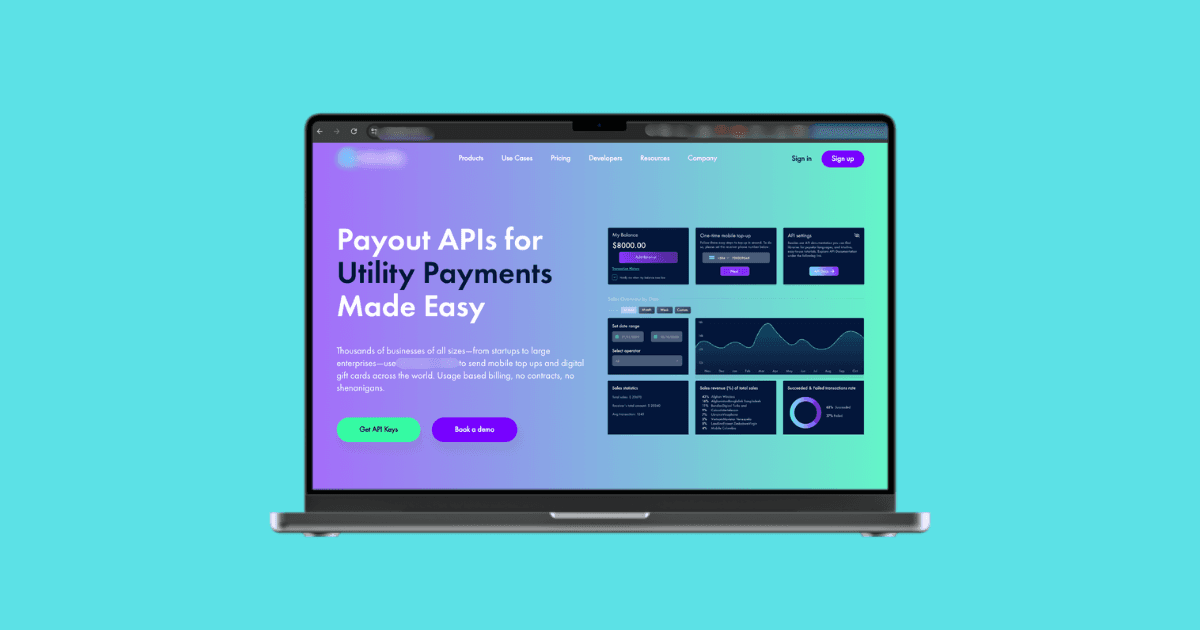
This B2B platform provides APIs for digital services. The primary goal of this project was to rebuild the site’s information architecture and resolve critical SEO issues, particularly those caused by poor JavaScript implementation and lack of original content.
By conducting a technical audit and redesigning both the content hierarchy and core landing pages, an extraordinary 40% increase in pages per session was achieved, and also built a scalable foundation for organic growth.
Background and Challenge
Business Context:
The company operates in a B2B environment where conveying detailed technical information in a clear and user-friendly manner is crucial for customer engagement and conversion.
Identified Challenges:
Poor JavaScript Configuration
Heavy reliance on client-side rendering (CSR) blocked key content from being indexed.
Search engines were unable to parse dynamically injected text, harming SEO.
Important UI elements like menus and CTAs were JS-dependent, causing load delays and UX inconsistencies.
Fragmented Information Architecture
Content was distributed in silos without semantic grouping.
Users struggled to locate technical documentation, use cases, or platform benefits.
Engagement Drop-off
High bounce rates and low pages-per-session metrics indicated friction in the content journey.
Organic traffic underperformed despite strong brand and technical capabilities.
Project Objectives:
Redesign the site’s architecture to be more intuitive and user-friendly.
Solve JavaScript rendering issues to ensure crawlability, indexability, and accessibility.
Clearly articulate the API capabilities to help potential business clients understand the value proposition.
Increase user engagement as measured by metrics such as pages per session.
Process and Methodology
Technical SEO & JavaScript Audit
Used Google Search Console, Screaming Frog (JS rendering mode), and Sitebulb to identify:
Non-indexable pages due to client-side rendering (CSR).
JS dependencies blocking text, metadata, and navigation links.
Late-loading content invisible to search engine bots.
Assessed impact on crawl budget and content visibility, especially for mobile and slow networks.
Information Architecture Redesign
Created a new content tree based on user roles (developers, product teams, fintech managers).
Structured content around:
Product types → API endpoints → use cases
Benefits → documentation → integration guides
Mapped internal linking to reinforce topic clusters and help bots discover deeper content.
Landing Page Framework
Designed modular pages supporting both business and technical value propositions.
Ensured progressive enhancement: core content loaded statically with JS as a complement, not dependency.
CTAs and key UX elements were migrated from JS-dependent interactions to native HTML wherever possible.
Implementation & Collaboration
Worked with devs to implement server-side rendering (SSR) or hydration fallbacks where possible.
Refactored code to expose crawlable HTML for critical content.
Aligned with stakeholders on UX wireframes and SEO content guidelines.
Implemented Solution
Technical Fixes
Resolved crawlability issues by replacing CSR with hybrid rendering for key pages.
Ensured critical metadata and content loaded statically.
Rebuilt JS-based menus and CTAs as fully accessible HTML-first components.
New Information Architecture
Introduced clean URL paths with logical hierarchies.
Improved content discoverability with breadcrumb schema, anchor links, and contextual in-page navigation.
Enhanced Developer UX
Embed code snippets, endpoint previews, and real-world use cases into redesigned landing pages.
Added quick links to technical docs, API keys, sandbox tools, and pricing calculators.
Results and Benefits
+40% increase in pages per session
+24% drop in bounce rate on product and integration-related pages
Indexation rate improved by 2.8x for previously JS-blocked content
+18% increase in organic impressions for product keywords within 60 days
Faster time-to-value for new users thanks to simplified navigation and better content visibility
Lessons Learned
JavaScript SEO is non-trivial: client-side rendering without fallbacks significantly harms organic growth.
Progressive enhancement is essential for both accessibility and indexation.
IA and SEO must evolve together—content structure and rendering logic are interdependent.
Cross-functional collaboration (SEO, Dev, UX, Content) is critical in technically complex environments.